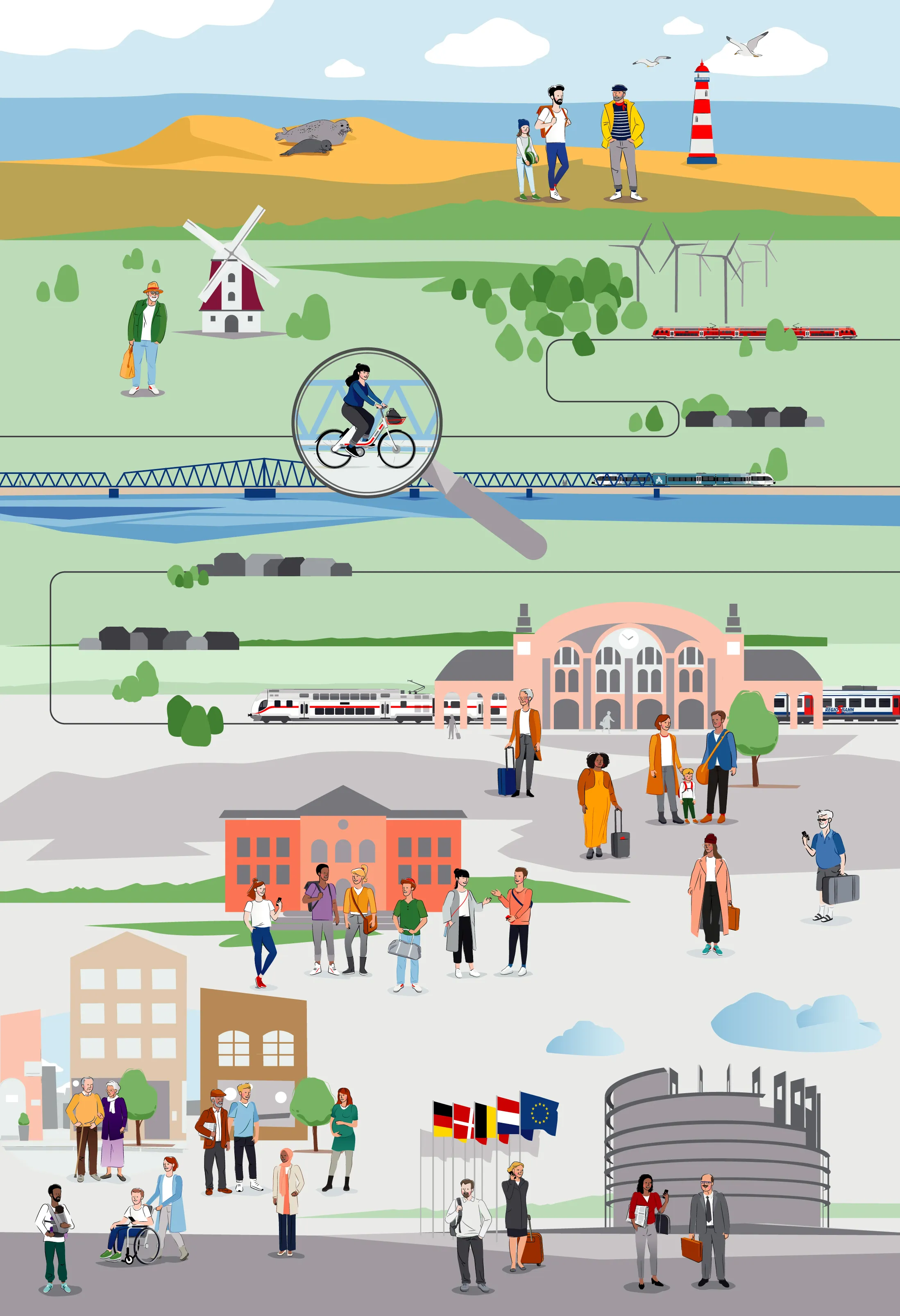
Wunderline and Friesenbrücke — Connecting without borders.
The cross-border railway connection between Germany and the Netherlands is an EU flagship project of European cooperation. The strong support for the project at the local, regional, national and European level is reflected in tangible backing. Since 2015, the European Union has provided funding for feasibility studies and the implementation of construction phase 1. Whether it's politics, business, railway companies or associations: on both sides of the border, everyone is working together to advance the project.
Up to 1,900 passengers are expected daily on the Wunderline trains upon completion of all project construction phases. Before 2015, there were around 700 passengers a day. There are several reasons for this growth: on the one hand, additional passengers from the region are expected; on the other hand, the significance of the route as a link in European rail traffic is being strengthened. Shorter travel times and higher capacities make the train more attractive for trips between Amsterdam, the northwest of Germany, Hamburg and Scandinavia. This way, even more distant destinations can be reached in shorter times.
Climate-neutral Europe by 2050, 55% reduction in greenhouse gas emissions by 2030: to achieve the European climate protection goals, emissions from transport must be reduced. This can only be achieved if more people are mobile in an environmentally friendly manner. Wunderline and Friesenbrücke are important building blocks for this. Shorter travel times, new stops, additional comfort and better accessibility make the train between Bremen and Groningen even more attractive – including for those who currently travel by car. The transition to more climate-friendly mobility is thus being achieved step by step.
Wunderline and Friesenbrücke span over 173 kilometres to connect two countries, the metropolitan regions of the northwest and Groningen-Assen, as well as numerous towns and communities in the districts of Leer, Ammerland and Oldenburg. Thanks to the modernised railway line and the new bridge with a separate pedestrian and bike path, people on both sides of the border can get to each other faster and more efficiently. This brings the cross-border region closer together economically and socially, resulting in greater connection and a higher quality of life in the north.
The northwest of Germany and the northern Netherlands have a lot to offer: water sports, hiking, experiencing nature, enjoying culture, exploring cities, shopping, indulging, being active or just relaxing. The environmentally friendly and comfortable option of travelling by train makes the region even more attractive to guests from near and far. For locals, this is doubly useful: on the one hand, they themselves can more easily take a day off nearby; on the other hand, more visitors from other regions and countries strengthen economic development in the north.
Living in one country, studying in another, comfortably switching back and forth and using the travel time to study: impossible? Not at all! Thanks to close cooperation between educational institutions, students in Groningen, Bremen or Oldenburg can complete their studies entirely or partially on both sides of the border. Bright minds use the fast train to get there. Greater capacity, short travel times and good WiFi in the trains make cross-border education easier. The Wunderline thereby sets the course for boundless education.
Scientific studies attest to the positive influence of Wunderline and Friesenbrücke on the region's economic development. For employees, this results in new possibilities for their careers and professional lives. For employers, being attractive and easily accessible is crucial in times of skilled labour shortages. With new stops, high-quality infrastructure and fast and comfortable mobility options, Wunderline and Friesenbrücke improve access to the cross-border labour market.